Living at human and artificial scale
On small places, and what AI displaces but cannot replace


“Small business” and “micro-entrepreneur” sound on the surface like synonyms. But the difference tells us something about how the question of scale—at which we live life, and the economy is organized—relates to our society’s present convulsions.
For the last eight years, I’ve been involved in starting and running a small business (a renovated cafe and one-room hotel) in Tokyo. In that span, I’ve seen it change from a quiet space with a small stable of local regulars, to a spot that shows up in influencer videos and fills up first thing in the morning with tourists who type “coffee” into Google Maps and sort by rating. Yet even with the greater mediation of technology, it remains a place where it is possible to engage meaningfully with the people who walk through the door, by nature of its scale, its physicality, and the connection of its story to the city around it.
The value of small businesses can be described in many ways, but I think about them in terms of relationships and rootedness—they contribute to lifeworlds in which it is possible to form durable attachments. They make the very idea of place possible.
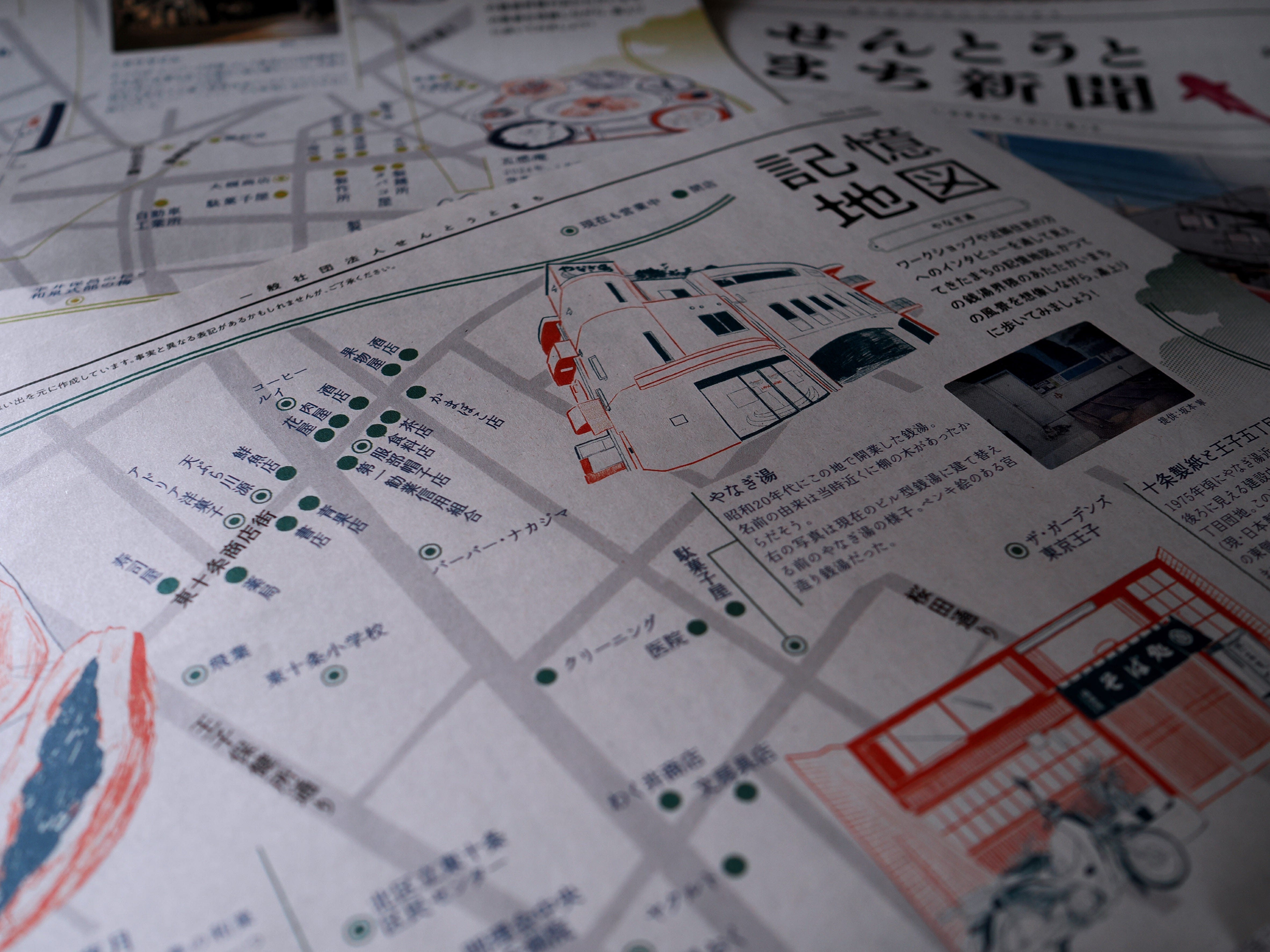
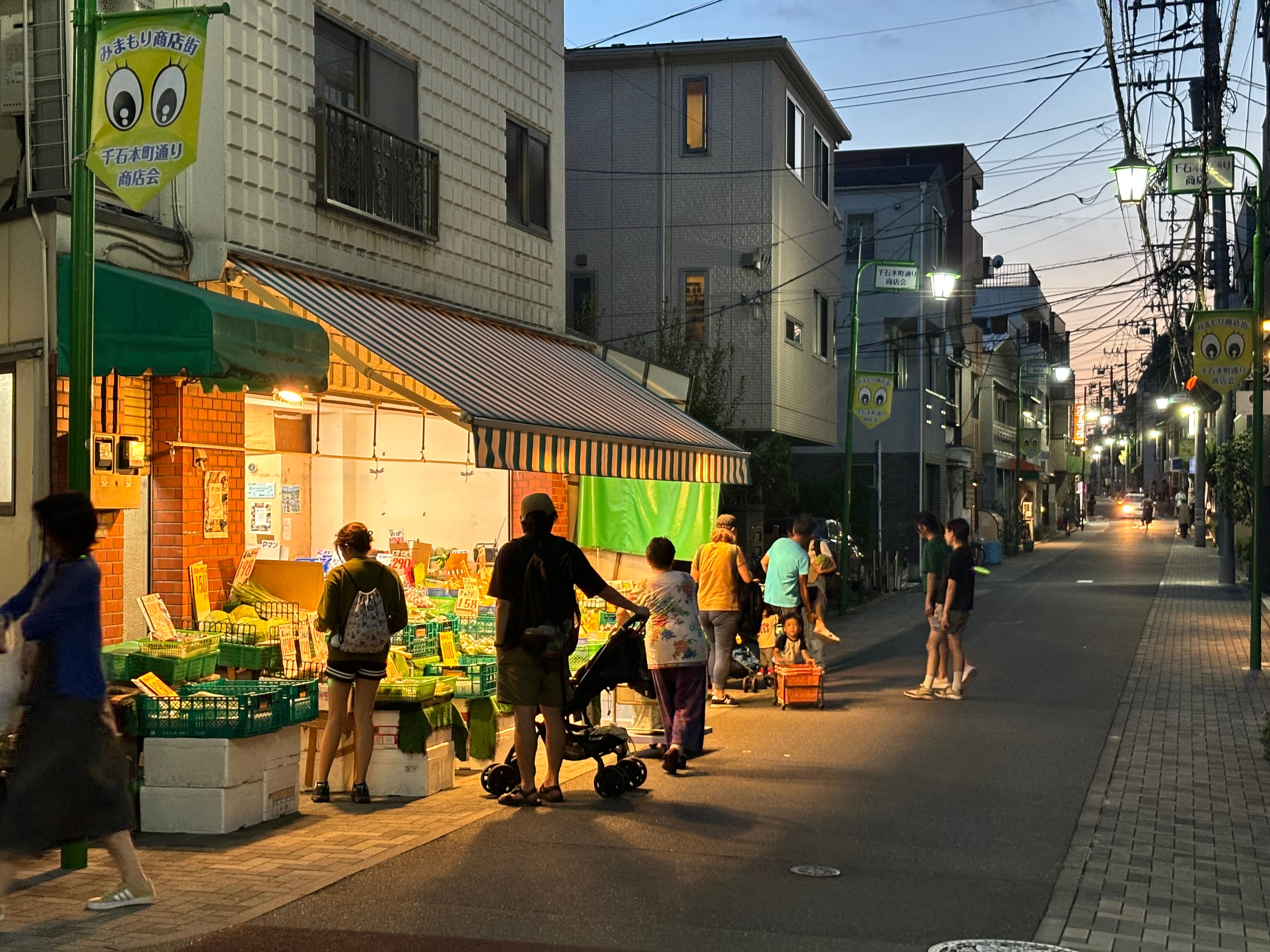
For the past three years, my non-profit organization Sento & Neighborhood has been recording and mapping memories of mostly vanished local worlds that once filled neighborhoods around public baths. In our workshops, small businesses are the vocabulary by which older residents describe their neighborhoods and the human webs that connected them. To walk down mostly shuttered streets, once filled with dense, coherent networks of green grocers, butchers, tofu and soba shops, is to weigh in their absence the profound erosion of the city’s social fabric. This erosion is also evident in the way most Tokyo residents today talk about their neighborhoods—not as places with human definition but merely as coordinates in space—15 minutes to Marunouchi, convenient to shopping, located in an area with rising real estate value, et cetera.
The decline of Tokyo’s small business ecosystems was brought about by supermarkets, real estate redevelopment, rapid transit, and other forces that tilted the playing field towards larger scale. Silicon Valley, at least until recently, had little to do with it. But digital services now sit at the center of the paradigm that has displaced local life—the city of one-click same-day delivery, algorithmic recommendations, and private spaces full of people staring at screens. Technology has relentlessly sped everything up, while amplifying trends of atomization and marketization.
It is in that context that I found myself thinking about the following comment by Anthropic’s Jack Clark on Ezra Klein’s podcast, in which he was asked to speculate on what kind of jobs might arise in a post-AI world where big firms slash white-collar jobs en masse:
One thing is just the phenomenon of the micro-entrepreneur. I mean, there are lots and lots of ways that you can start businesses online now, which are just made massively easier by having the A.I. systems do it for you […] if you’re a person with a clear idea and a clear vision of something to do a business in, it’s now the best time ever to start a business.
The reflex to talk about how AI empowers the little guy is unsurprising. It taps into Silicon Valley’s origin story of garage startups, and is certainly more reassuring than the notion that a handful of companies are amassing enormous power on a planetary scale.
But if now’s the best time to start a business, why’d they all disappear? The reason, of course, is that “micro-entrepreneurship” in Silicon Valley speak does not mean building something at a local scale to serve your neighbors. These days, it more often means launching an online storefront, using a chatbot to create a brand identity, and paying a manufacturer in China to ship directly to customers captured from an algorithmically selected audience on social media. This ideal is taken to its logical extreme by the AI billionaires, who make bets in their group chat about when the first one-man, billion-dollar business will be created (pity on that lonely soul).
The micro-entrepreneur is a solitary figure: a founder pitted against abstract market competition, or much less glamorously, an influencer (or podcaster/Substacker) hustling day and night to stay on the algorithm’s good side. They are valorized for different reasons than small businesses. Startups are supposed to scale; they are lauded for driving innovation and destroying bloated incumbents—in other words, for keeping the economy in a constant state of flux. Durability is the enemy of progress and growth. Meanwhile, much of the lasting value accrues to the platforms.
And so it is that we find ourselves in the late-stage AI bubble, when the promise of “AGI” has been delayed to an indeterminate future and the tech world has decided that the interim solution to our problems—and their multi-trillion dollar expenses—is…more apps. Lately, alongside one micro-entrepreneur’s ads of an extremely buff AI-generated older Asian man pitching a taichi workout guide for over-50 dads, YouTube has been serving me promotions for vibe coding startups that promise me that I can now create anything I want just by thinking about it. The smallest inconvenience, the slightest pang of boredom or yearning for companionship, is now a problem to be solved by a bespoke piece of software.
These tools are surely useful in certain context, but what happens to life when everything is in a constant state of flux, when everything is made “easy”? What LLMs have given us in the digital realm is a removal of friction. And now we are also waking up to the value of the friction we have lost: the meaningful rewards derived from effort and attention, the ability to form durable attachments and knowledge, and importantly, the legibility of a world that is not overrun by meaningless symbols and artifacts.
What keeps the onrush of slop at bay in the physical world—and what makes us appreciate a small business owner who shows up everyday—is the far greater friction involved. Yet according to tech utopians, after swarms of agents swallow the internet, AI is coming for the physical world, too. “The robots will actually make so many robots and A.I. that they will actually saturate all human needs,” claims Elon. “You won’t be able to even think of something to ask the robot for at a certain point. Like there would be such an abundance of goods and services.” However implausible, it should be obvious that in such a scenario meaningless symbols and artifacts would quickly proliferate to drown out what remains of the human world.
We should all know from our experience of the last two decades where this AI hype is leading us—further into a digital morass that has left us more isolated and unfulfilled. The AI salesmen know we know this, and thus lean harder upon faith in the singularity or other flavors of utopianism to reassure us that something better and more abundant is just over the horizon. The digital drudgery will finally end, the bullshit jobs will melt away, and humanity will be liberated to pursue art, creativity, order our robots around, and perhaps invest our time in forming durable attachments again.
But if a more human future and richer cities do arise in a post-AI world, they will come through cultural and political movements to disengage from digital technology, and sustained efforts to create networks in the real world. Protecting and cultivating the common spaces within our cities, uncommodified human relations in our lives, and unmediated realms inside our minds is a process that should be difficult and full of friction. If it’s easy, we’re not doing it right.
Thank you for sharing this thoughtful piece. I also agree that there is real value in effort and friction. It made me reflect on the importance of small places and the connections they create.
Loved this essay and thank you, as always, for sharing your thoughts. Some of what you wrote here helped me put to words my own experience of living life at a human scale. Here's the blog with your quote: https://buttondown.com/StreetHaunting/archive/quick-commerce-life-at-human-scale/